Most of my books have sprung from similar experiences that could have been ‘far memory’. The Tower and the Emerald was written incorporating an experience I had at a stone circle in Derbyshire, where all the stones are lying down on the earth as though pushed down by a giant hand. There I felt that there was a body buried at the centre who had been cursed so that his soul could not leave that place, ever. He seemed to be pleading with me to release him – but I resisted because I thought he might have been pinned there for a good reason, that is, that he was under the influence of an extremely evil force. I walked away. But that night, and for four nights following, I had a recurring dream in which I was one of the priests that had cursed him and buried him. I saw that we broke both his legs so that he could not run away while we performed the ritual.
I realised I would never be free of the dream unless I freed him. Besides – it seemed to me that on one had the right to deprive a soul of its freedom to repent and be redeemed. I went back to the circle and prayed that he would be released to the care of the Angel Gabriel and the Christ (as sort of celestial probation officers). The disturbing dreams ceased.
Months later, a friend, to whom I had told the story, told me that she had visited a local museum and discovered that there had been a burial at the centre of the circle – and that the body had both legs broken.
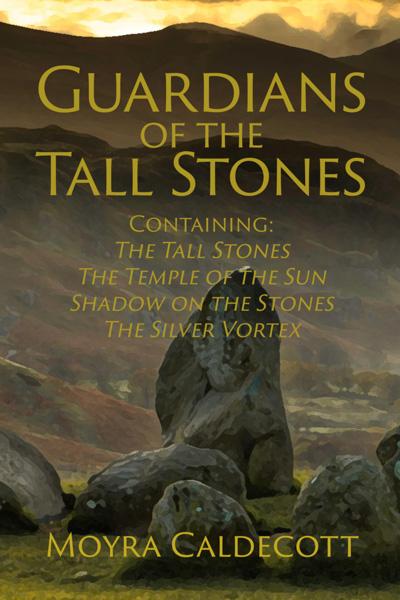
My most successful book, a trilogy of novels set in the Bronze Age of Britain, now in one volume called Guardians of the Tall Stones, still in print after 24 years, started off from an experience I had in a stone circle at Dyce, near Aberdeen, in Scotland. I had angina at the time and after several heart attacks was living for each moment very intensely and gratefully. I was only in the circle for a few moments, but felt I had experienced a life time there. I began to write – fast – determined to get it all down before I died.
My main character was Kyra, a young girl who found she had psychic abilities and was therefore chosen to train as a priest in the Temple of the Sun, far to the south, at Avebury.
In 1976 as I lay in St Thomas’s hospital in London after a severe heart attack, not believing that I would be alive in the morning, I watched a star through the huge plate glass windows slowly crossing the sky.
I wrote the following as though it was happening to Kyra at Avebury, but to me it was at once my own experience that night in hospital and the experience I was ‘remembering’ from that ancient time. Linear Time had ceased to exist.
On a clear, moonless and cloudless night, she entered the great Stone Circle of the Temple and lay upon her back on the grass, her feet towards the East where the Sun would rise.
She was alone and the whole night was hers.
This night she must not let her attention wander for an instant.
The Star the High Priest had chosen for her was rising at the moment she lay down and she must watch its progress across the sky, unwaveringly the whole night long. No matter how tired her eyes became she must not let it out of her sight for an instant.
The effect of the high earthen ridge around the Circumference was to cut out all sight of the landscape and the villages around. She was isolated in a Circle of Power in complete darkness, alone with the Stars.
As the night progressed she totally forgot herself lying on the grass. All that existed was the one star she followed, brilliantly in focus, while an incredible pattern of subtly changing points of gold moved round in the background of her vision.
The star she watched not only moved with slow but inexorable majesty across the dark forever hole of the night sky, but grew in brightness and in power until she felt it like a sharp needle point actually penetrating the centre of her forehead.
It seemed to her the earth bank and the Tall Stones surrounding her not only kept the rest of the world out, but concentrated the power of the stars and whatever realms of Reality that lay beyond her normal consciousness, until they grew in strength and became the only Reality of which she was aware.
It seemed to her the needle of the Star she watched pinned her through the centre of her forehead to the earth and she could not move her body. In her stillness she could feel the earth moving. She was no longer loose upon its surface but was joined to it by this thin, sharp beam of force that passed from the Star to her, through her into the earth, and through the earth until it came out the other side to continue its journey…
Her mind ached with the strain of thoughts that were coming to her.
Her forehead ached with the pain of the sharp beam passing through it.
She felt very strange as she turned with the earth, feeling the earth move and the Star stand still.
But the thought she was trying to grasp kept returning until at last her mind could encompass it.
It was the realisation that the beam of force from the star that was passing through her and through the earth, and through the universe beyond, was returning to the Star of its origin from the other side!
As though the Whole Universe was a sphere, yet of such a kind that there was no material solidity to it whatever, and therefore no bounds of inside and outside.
She was like a bead on a necklace, threaded through the line of force that was curving with the Universe.
As she grasped this there seemed to be a kind of brilliant explosion in her mind, or was it in the sky?
But suddenly, from every star in the sky, there seemed to be the same fine beam of light, and each one was threaded through the pain in her forehead, through the earth, and through the Universe beyond and back again to its original Source.
The sky now instead of being black with separate points of light, was criss-crossed with fine arcs of light, each starting in a star, or …
Did they start in her hear?
She could no longer tell if she was the centre from which all the beams were coming, or whether she was the passive recipient of the beams from the stars.
Was she the beginning of all things?
She?
Who was she?
She could not remember her name.
She thought and thought in a sudden kind of panic…
“What is my name?”
But she had no name.
The more she tried to remember the more the beams passing through her head hurt her.
At last exhausted and in agony, she accepted that she had no name.
And with that acceptance the pain ceased, and she lay in wonder, watching the cycles of light weaving their magnificent pattern all around her and through her.
The beauty of it! The blissful peace and happiness she felt that anything could be so perfect occupied her for the rest of the night.
And when the sun slowly rose and the vision faded, she remembered her name.
And with the remembrance she moved and felt pain in every limb.
Slowly she dragged herself to her feet and looked round her with weary and bewildered eyes.
The dawn light revealed the Circle as she had known it before, the grassy bank, the giant Stones. Above her the first flights of birds called cheerfully to their fellows.
[Moyra Caldecott, Guardians of the Tall Stones, p.303]
More soon…
Multi-Dimensional Time: Part 1
Multi-Dimensional Time: Part 2
Multi-Dimensional Time: Part 3